





This week’s highlight
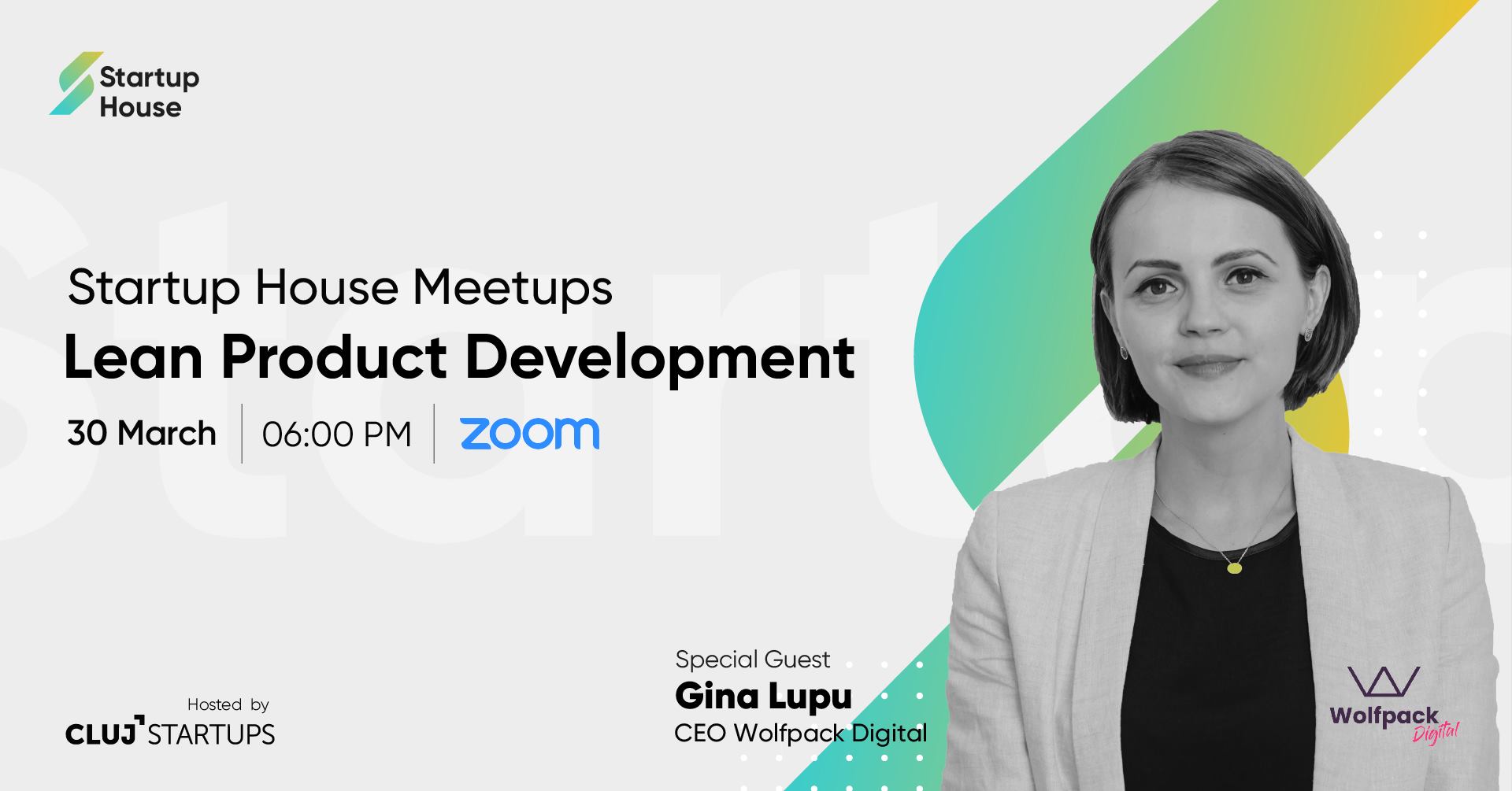
The Founder and CEO of Wolfpack Digital, Gina Lupu, has met with Cluj Startups to talk about Lean Product Development on the 30th of March.
This meetup aimed to connect startups founders with corporates, investors, services providers, and mentors, and also with the Lean principles.
Coming from a diverse background, from Engineering to PR, Psychology, and then Business Management, Georgiana Lupu is the founder and CEO of Wolfpack Digital, an award-winning web, mobile design and development agency in Cluj with a team of 60 people.
Wolfpack Digital also builds internal digital products, one of them being the first integrated health tech treatment for gambling addiction. She is also on the Board of Directors of Transylvania IT Cluster and co-founder of Women in Tech Cluj.
It’s all about the process
The Lean Product Development uses the Lean Principles to dissolve the ever-growing challenges of Product Development.
It is not about having a great idea but about implementing the proper process. Eric Ries says in “The Lean Startup”, the book that Gina highly recommends, that often “entrepreneurs take a <<just do it>> attitude, thus avoiding all forms of management, process, and discipline”, which leads to more chaos than it does to success.
The three fundamental pillars of the Lean Development Product
- Acceleration of cycle times
- Focus on what the customer wants
- Validated Learning (Scientific learning, Science for decision making)
Make the most out of your MVP. Build fast, test, assess your successes and failures, take your validated learnings, and go to the next stage with an improved product based on factual data.

An MVP is not necessarily the smallest product; it is simply the fastest way to get through the Build – Measure – Learn feedback loop with the minimum amount of effort (it can even be an ad or landing page, just like Dropbox started).
Most of us might think that the minimum viable product is the same as a prototype or a concept, but unlike these, an MVP is built to answer the entrepreneur’s questions and basically to test fundamental business hypotheses.
Gina’s recommendations
- Now is the time. With the pandemic going on, the tech industry wasn’t affected that much, or at least it created a boost, and now we have accelerated digital transformation;
- Use proper tools for product development and team management, for example, Trello or Jira;
- Speed and quality should be seen as dual; we need to know when to prioritise (deliver in small batches and use validated learnings);
- All your assumptions need to be stated and tested;
- Here are some helpful articles about project management.
Words to lean by
- Choose metrics carefully (even when you’re thinking of the number of users who gave up on your product), focus on one baseline at a time, go for sustainable growth, and pivot when the results tell you to do it.
- Focus on today’s problems rather than tomorrow’s possibilities and when you’re in doubt, simplify!
- Do not neglect strategy and be too adaptive; this is a “just do it” mindset that successfully failed too many times in the past.
“Eventually, the Lean Startup blossomed into a global movement”, says Eric Ries in his book, and this was the main idea of the event. Entrepreneurs are starting to realise that people don’t know what they want, making their job harder.
When you are new on the market, it’s easy to ask the customer what they would like to see in your product but making assumptions based on factual data makes your startup lean and your product sold.
And that’s what a Lean Startup is based on.